
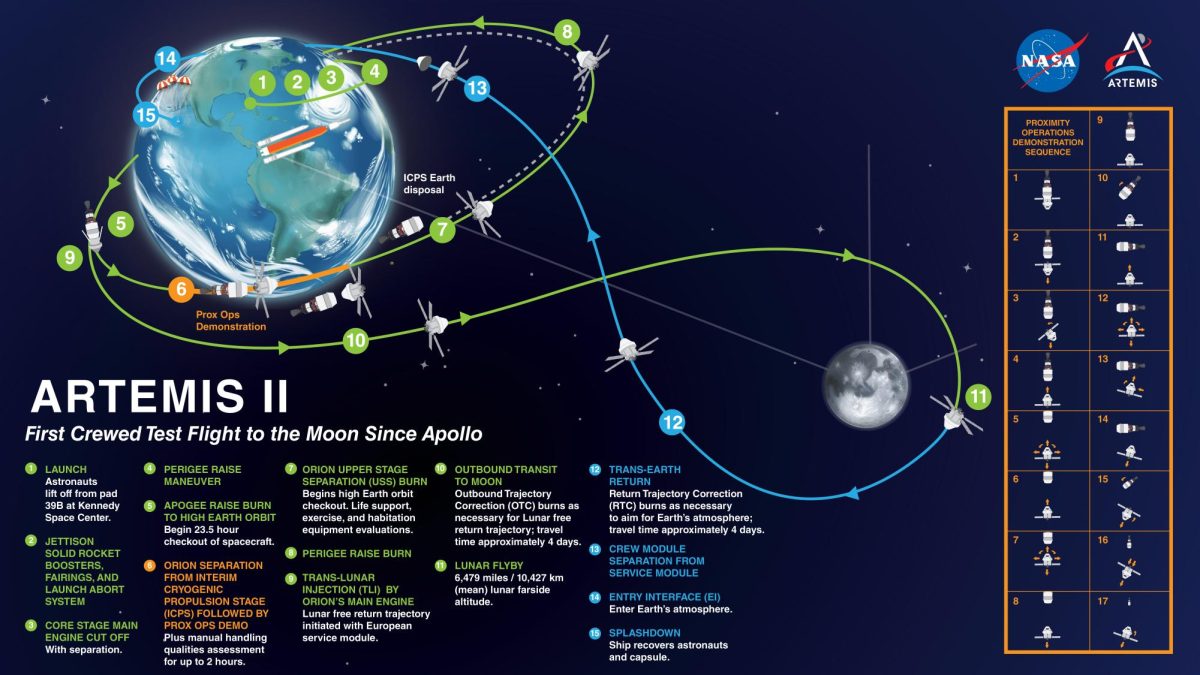
We are going to the Moon… or at least that is what it sounds like. In actuality, Artemis II isn’t going to land on the Moon like the Apollo missions but it is our first time back to the Moon since 1972 during Apollo 17 which was the last manned lunar mission. Additionally, Artemis II is vastly different from Apollo in several aspects. The main difference is, of course, that the Apollo missions landed on the moon and had people walk around. Now while Artemis does plan to land on the Moon with Artemis III, this isn’t planned until 2027 or 2028 and is expected to land on the South Pole of the Moon instead of the equator where most of the Apollo missions had landed.
What Artemis II is essentially, it is a flight test similar to Artemis I which tested not only the rocket used to propel Artemis astronauts to space called the Space Launch System (SLS) which is more powerful than the legendary and iconic Saturn V which took Apollo astronauts to the Moon. Additionally, Artemis I also tested the Orion spacecraft. Orion is the spacecraft expected to house the four astronauts on Artemis II and the Artemis I proved to NASA that Orion could sustain humans and keep them safe from things like radiation and overall according to NASA, Orion passed with flying colors. Albeit, with one major issue. During Orion’s return to Earth which involved having to dive through Earth’s atmosphere which at the speed of which Orion was traveling, it compressed the air in front of the craft long with massive amounts of friction generated with both of these causing immense heating. Hence why a heat shield is needed to protect not only the craft but the future crew as well. However, upon analyzing the heat shield after Orion had landed, they had found some issues with the heat shield, namely that the shield had cracked causing charred material to break off.
The cause of the issue was identified as gas buildup within the heat shield’s material called Avcoat. This gas without being able to properly vent and escape caused a pressure build up and cracking. This then allowed for pieces of charred material to break off. NASA’s solution to this problem comes in two parts. Firstly, for Artemis III and beyond, the organization has gone ahead and begun to develop a better formulation of Avcoat to prevent gas build up since Artemis III still hasn’t had its heat shield installed. However, for Artemis II, Orion already has its heat shield installed and replacing it would be inefficient so instead, NASA worked out changes in reentry maneuvers for when Artemis II returns to Earth to prevent charring
Apart from taking astronauts around the Moon, Artemis II will also be taking humans out further into space than ever before breaking the record held by the Apollo 13 astronauts who traveled 400,171 km (248,655 miles). This is done mainly because of the figure 8 flight path the spacecraft will take to return to Earth will take it behind into the far side of the Moon. However, this also serves a dual purpose by testing out Orion’s deep space capabilities which will be essential in future space missions especially Mars missions. In comparison to Apollo, Artemis II is comparable to that of Apollo 8 as both of them tested their respective crew modules, however, Artemis II is a little different.
Recently, on February 2nd, to ensure all systems were nominal, NASA did a wet dress rehearsal which was prepping the rocket engines to be fueled without launch in order to simulate the long wait that rockets experience before lift off. However, in the rehearsal, NASA found out of a liquid hydrogen leak within the fuel tanks in the SLS and therefore called off the February launch window to fix the leak alongside other problems that were also found during the rehearsal. Although, having a hydrogen leak sounds scary, in actuality, they are fairly common as due to hydrogen being the smallest and lightest element on the periodic table, it readily escapes through the smallest microscopic gaps in between seals and welds. Additionally, liquid hydrogen has to be extremely cold to be stored as rocket fuel at around -423 degrees Fahrenheit. This frigid temperature allows for thermal contraction to occur because as things cool down, their molecules slow down which reduces the space between them and causes a material to shrink. In the case of the SLS, this shrinkage allows for even more ways where hydrogen can leak and escape from.
Artemis II is expected to launch sometime in March with potential launch windows during March 6-9 and the 11th. Hopefully, this time the testing goes smoothly and we can get one step closer to reaching the Moon once more.